
REVIEW: WNO Death in Venice & Così fan tutte at Mayflower Theatre
- Owen Noon
- Mar 21, 2024
- 9 min read


The Welsh National Opera (WNO) is back at Mayflower Theatre with their exciting collaborative telling of ‘Death in Venice’. This is so much more than just an opera. Exploring several themes 50 years after its premiere, Benjamin Britten is a British titan in 20th-century opera, and his final operatic piece of work is brilliantly brought to life by WNO. Inspired by the original novella by Thomas Mann, and with a 1971 film of the same name following, this English sung opera explores when imagination collides with reality and the battle between opposing personality traits.
This is my third WNO opera now, and it was completely unlike the other two productions that I had seen (in a very good way of course). With it being sung in English, it automatically made the story that much easier to follow. There were also surtitles above the stage still, for if you couldn’t quite understand how they were enunciating. This opera was actually in collaboration with NoFit State, a circus company casting ‘Tadzio’ and his family with circus performers, acrobats and dancers. Because these particular characters never talk to the protagonist of the story, what better way to accentuate their performances than through another individual art form. It’s almost ‘Cirque du Soleil’ meets opera. Director, Olivia Fuchs, has done a great job orchestrating a smooth collaboration not only between multiple art forms, but also collaboration between the production team and cast.
As a quick summary, the story follows renowned author ‘Gustav von Aschenbach’ in his search for beauty and meaning as he travels to Venice. In the middle of a cholera epidemic, not all is lost as he falls in love with a youthful aristocrat who happens to be staying in the same hotel (‘Tadzio’). As ‘Aschenbach’ projects his loneliness and love upon him, he starts to merge his fantasy and imagination with reality before becoming increasingly divorced from his reality.
There were so many layers to this cast and they were all fantastic. The main man ‘Aschenbach’ was played by the brilliant Mark Le Brocq. His passion and the way he told the story, not only through the power in his voice but also in his stage presence and direction was perfect. He basically never left the stage, and the moments after it was just him, his voice, and the music, you could literally hear a pin drop. Bravo! Another shout out also needs to go to Roderick Williams, who plays more characters and wore more hats (almost literally) than I have fingers. Amazingly energetic performance. Talking on highly energetic performances, ‘Tadzio’ was played by the incredible Antony César. The things that Antony was doing with his body, and the way he wasn’t only doing them but was telling a story through movement was sublime. The mixture of dance, gymnastics and acrobatics was pinpoint perfect, especially the spinning splits and rings routine. Antony’s pieces with Riccardo Saggese were also ridiculously impressive, and the strength and power shown leaves you speechless. Circus director, Firenza Guidi, has directed all of the circus performers (Selma Hellmann, Diana Salles, Vilhelmiina Sinervo) to bounce perfectly off of each other (sometimes literally), but also off of the impressively grand ensemble. The ensemble heightened the overall scale and meaning to certain scenes making it feel more theatrical and cinematic at the same time. Each individual section was so cohesive in coming together from telling their own version of events, to tell the final version of this story. Hugely impressive in multiple different ways.

When it comes to the set, well there actually wasn’t much of one. But there didn’t need to be. There were little bits of set that were brought on, as well as 4 pillars and flight attachments for the acrobats but that was it. This worked really well because the cast became the set. The mix of lights with where the cast were placed, or where/how the acrobats were moving was extremely effective. I particularly liked how they did all of the boat scenes throughout act 1 - very minimal with maximum effect. There was a full length projection screen at the back of the stage showing things to help set the scene like the beach or rain. From where I was sat, it wasn’t too noticeable in all fairness but it was nice to see an added bit of movement when there wasn’t any. Lighting designer, Robbie Butler, has clearly worked very closely with Olivia Fuchs (director) and Nicola Turner (designer) to ensure that the the light movement helped project the story as much as the cast and company on stage were. I remember thinking that the light was indicating direction throughout the piece, whether this was intentional or not it didn’t go unnoticed.
Britten’s brilliantly cinematic score was played out by the WNO orchestra who never fail to add an extra layer to WNO’s operas. Mixed with the impactful singing, the orchestra are the cherry on top of the cake. You actually ended up forgetting that it was live music being played, it just felt like we were watching a movie. The opera is told in two acts, with act 1 almost setting the story up with context and information and act 2 being the rest of the bulk of the story. Personally I thought that act 1 started a little slowly, but this was quickly rectified and before you knew it 80 minutes had already passed and it was the interval. I particularly liked how all of the individual arts had their moment in the spotlight. There were moments where it was purely operatic with ‘Aschenbach’. There were times of musical interludes from the orchestra. There was times when it was just the circus performers from NoFit State, and there were times when it was just the chorus/ensemble doing their bit. When they all came together, the collaboration created a beautiful piece of art.
‘Death in Venice’ wasn’t just an opera. It was theatre, cinema, and the circus all rolled into one thought provoking story. The chorus moments gave off similar vibes to musicals such as les miserables, the score played by the orchestra was straight out of a Hollywood movie, and the circus - well that speaks for itself. There is little bit of something for everybody in this opera and if you’re new to it - it would be a perfect one to introduce you. The fact that this is also performed in English, makes it that much more accessible. It would be really great to start seeing a younger audience make their way to operas around the country, and WNO are doing all the right things in aim of this - so keep an eye out for when they’re touring to a theatre near you and maybe give it a try yourself.
Così fan tutte
The Welsh National Opera (WNO) is back at Mayflower Theatre with their second piece of their Spring collection in the all new ‘Così fan tutte’. Technically speaking, ‘Così’ (as I’ll call it from now on), is an opera composed by Mozart that was first performed in 1790. WNO’s production is a completely new and updated twist on this - and I think it was the right one. Alternatively named, ‘The School For Lovers’, this version of ‘Così’ is set in the 70s following four sixth formers discovering what falling in love is and all the emotions that come with it. ‘Così fan tutte’ literally translates to “So do they all”, using the feminine plural (tutte) to indicate women. This basically paints all you need to know about this opera and in hindsight is incredibly important.
I’m starting to understand opera more and more, and in particular how WNO keep things fresh in trying to open opera’s doors to the masses. I think this adaptation shows this more than any of their productions I’ve seen so far. This Italian sung opera is said to be the perfect ensemble opera with 6 different roles almost equal in weight and performance, without an individual ‘leading lady’. As always, the show is accompanied with English surtitles and leaving the theatre I remember thinking that this is the first opera that I haven’t struggled to follow along with once. I always read a brief synopsis of the story before hand, and I think I would have still been able to follow along perfectly if I hadn’t done that. This is all thanks to the clarity in how the story is both set, told and directed - something director, Max Hoehn, should take high credit for.
The way in which they have adapted this story is actually extremely clever. Reading about it before hand, all I could think was how dated and cringe worthy this was going to be - and don’t get me wrong, the themes and some of the things they were saying still definitely were. BUT, in the context of a 70s sixth form, it made so much more sense. It slowly became more relatable and more acceptable in its satirical form. To try and give some context to my review and summarise extremely briefly: Four students are given a valuable lesson in love, life and liberty when their teacher involves them in a secret experiment. Testing the limits of their love in a bet of temptation, the boyfriends leave and come back disguised to see if each others partners stay loyal to them or not. Yes, it is just as weird as it sounds.
As I’ve mentioned, the cast comprises of 6 people (and WNO’s brilliant chorus). As WNO have stated, ‘Così’ is probably Mozart’s opera that is most dependant on the chemistry of its performers, and their performers have smashed it. Making their WNO debuts were Kayleigh Decker as ‘Dorabella’, Egor Zhuravski as ‘Ferrando’, and José Fardilha as ‘Don Alfonso’. They were joining Sophie Bevan as ‘Fiordiligi’, James Atkinson as ‘Guglielmo’, and Rebecca Evans as ‘Despina’. Decker, Zhuravski, Bevan, and Atkinson were amazing as the sticky quad relationship. It goes without saying that their voices were just incredible, usually in operas there is a majority of individual singing but some of the harmonies I heard tonight were pitch perfect. As well as this, the emotions that they portrayed when they weren’t singing was amazing, something that really helped the story flow along so easily. The comedy and chemistry between them all was incredibly natural. I also really like that in Act 2, they all had their individual time to shine with big solos. Just amazing! Fardilha and Evans were also a fantastic comedy duo, that almost acted as the ‘voice of reason’, but also not in some crazy way. When WNO’s chorus came into play, there was a huge sense of musical theatre which heightened the whole value of the opera. Outstanding overall.
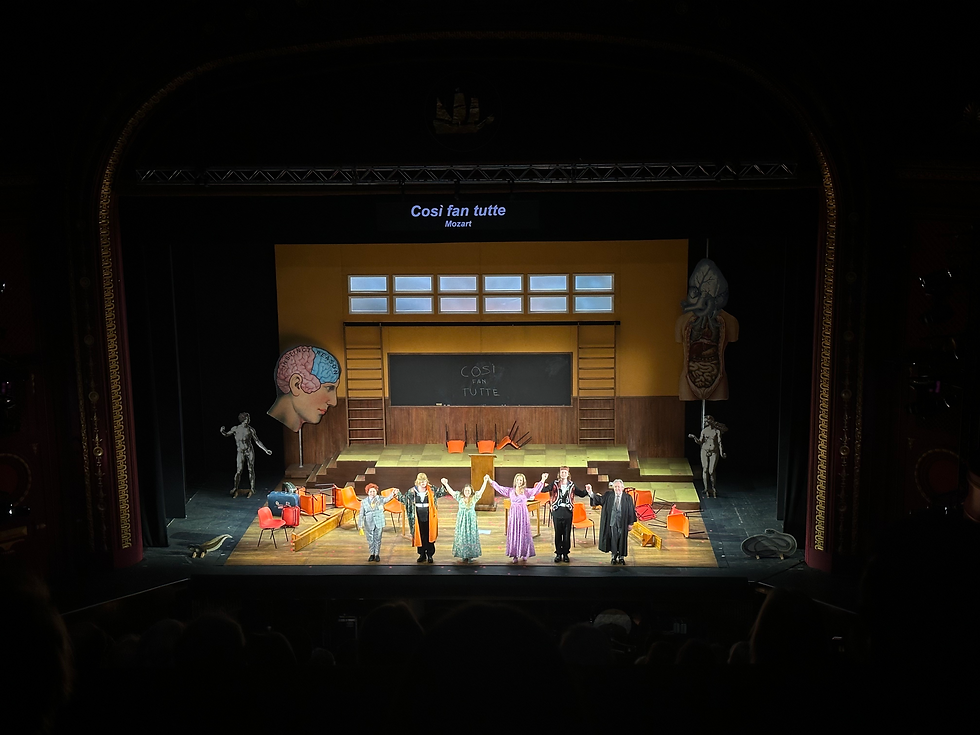
As for the set, it was actually very good! Reminiscent of a musical in many ways. The main bulk of the set was a 70s school classroom, with a heightened stage and chalkboard that slides to reveal a canteen. Not to forget those nostalgic wooden wall bars that I’m sure we all remember! Along with this were some brilliantly crude flats featuring modern day nods to phallic and sexual culture - we all know what the cherry and grapefruit mean… The moving pieces of set, like the lockers and desks were again very reminiscent of a modern musical and it worked with what they were going for. The lighting design was also very simple, but very effective. The change in colour to show emotion as well as day/night was very clever - and especially effective coming through the windows at the top, to only lighting half the stage creating the effect of a real window. The whole locker scene was also just bonkers, but in a good way!
I’ve mentioned already how some of the language used throughout the opera was dated and would definitely not cut it in todays day and age. I stand by this even if put in a comedic way through context. But if you were to take it out, you’d completely miss the point of the story. You have to remember that it’s from the 18th century so it’s not going to be politically correct today. Saying this however, there was so much about this opera that I really enjoyed. For one, the comedy used was brilliant. The mixture of physical, slapstick, clever scripting/timing and subtle fourth wall breaks - all brilliant! There was a particular point when they used the chalkboard to draw a boat with 2 stick men waving, and the use of irony was staged and timed to perfection. I also really liked all of the whisper lines where they’re meant to be talking to themselves, but in effect are talking to the audience instead.
As always, the wonderful WNO orchestra played out some of Mozart’s most ravishing music headed by conductor, Tomáš Hanus. A live orchestra can heighten any story, and WNO do it perfectly. ’Così fan tutte’ is an opera that is over 3 hours long. This is enough to put anybody off, and I was really worried that you would be aware of how long it was going on as well. However, it flew by just like watching a movie. I actually wrote in my notes: come act 2, you had forgotten it was an opera and you were now instead watching the wildest, weirdest, and whackiest romcom of all time. There were more twists and turns than a rollercoaster or series of Friends (sorry for the cliché!). One major thing that I’ve taken from this production is that WNO are smashing it and I can’t wait for their next instalments. If you get the chance to watch ‘Così’ before it finishes for the season you cannot skip it, but if you don’t get the chance - find out when WNO are coming to a theatre near you and try open your eyes to an opera. You won’t regret it!


Comments